Founded in 2024 as a spin-out of Walther-Meißner-Institute (WMI), Peak Quantum builds high-quality quantum processing units (QPUs) based on superconducting qubits. The founding team helped establish the superconducting qubit program at WMI and Technical University of Munich, building a full-stack quantum lab from scratch.
The quantum computing industry spent years chasing a single number: qubit count. But more qubits don’t help if each one is unreliable. Today’s machines lean heavily on quantum error correction, often requiring thousands of noisy physical qubits to encode just a handful of stable logical qubits. Peak Quantum addresses this overhead challenge at the physical layer. The company has developed a novel qubit architecture that suppresses errors directly in the hardware. Fault resistance becomes a physical property of the chip itself, dramatically reducing the redundancy quantum error correction demands. The result is lower error rates, fewer physical qubits per logical qubit, and a direct scaling and cost advantage on the road to fault-tolerant quantum computing.
Key credentials:
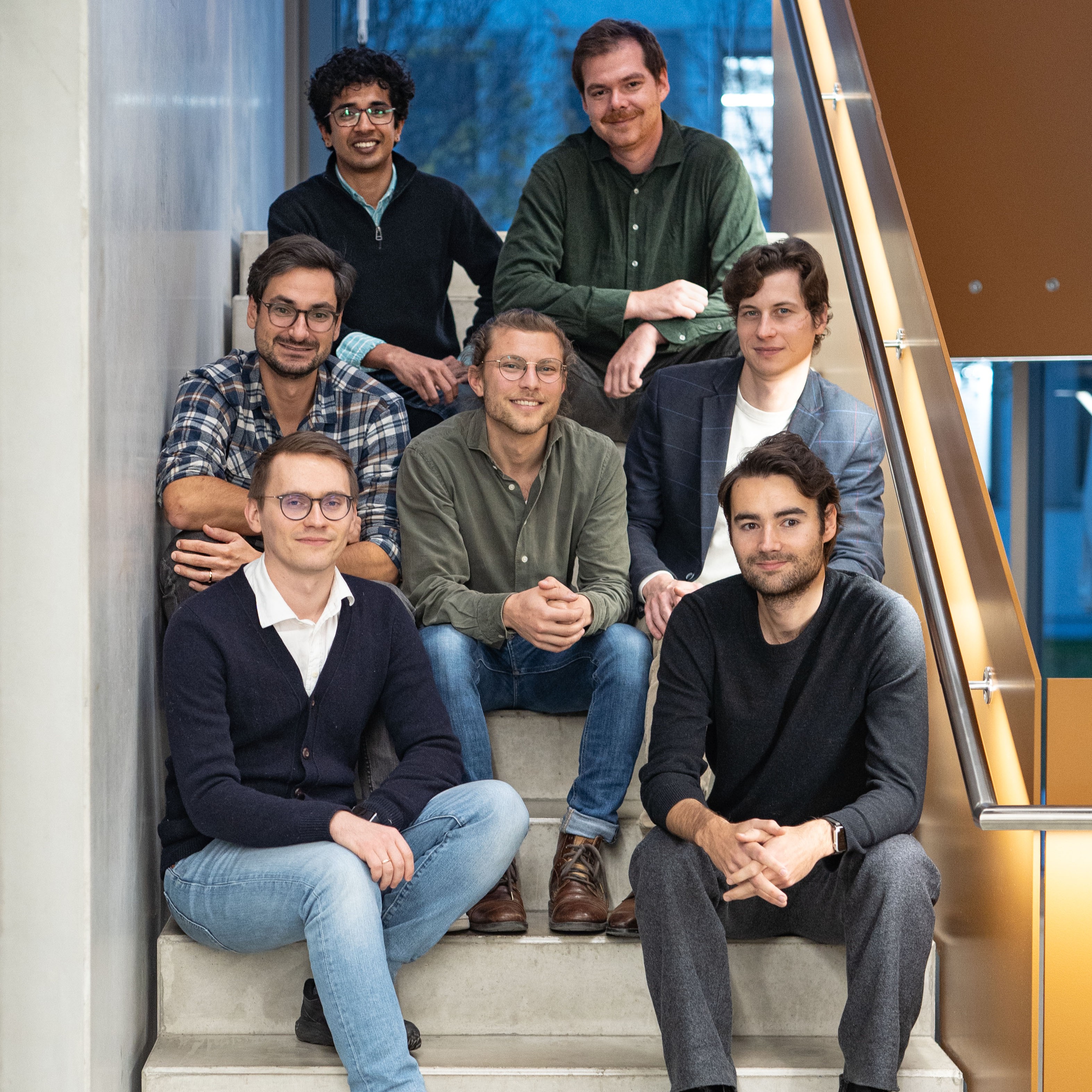
Peak Quantum was founded by a team of six researchers and operators who helped build the superconducting-qubit program at the Walther-Meißner-Institute and TUM's Chair of Technical Physics, paired with commercial and operational leadership to turn that research into a company.
"The quantum computing industry has focused too long on scaling the number of qubits, but more qubits don't help if each one is unreliable."— Leon Koch, CEO
Leon Koch — CEO & Co-Founder. A physicist trained at the University of Tübingen, Leon conducted his doctoral research in superconducting qubits at WMI as Prof. Stefan Filipp's first PhD student. Before Peak Quantum, he founded and ran his own company. He leads product and company strategy.
Dr. Thomas Luschmann — COO & Co-Founder. PhD in Physics from TUM and a researcher at WMI. Previously co-founded and managed AETHER GbR. Leads operations and Peak Quantum's manufacturing scale-up.
Dr. Max Werninghaus — CSO & Co-Founder. PhD in Physics from TUM and Saarland University, with research experience at IBM Research Zurich and as a researcher and quantum-control group lead at WMI. Leads scientific and technology strategy.
Alexander Schult — CFO & Co-Founder. Brings commercial and finance leadership, having previously co-founded a company that reached a successful exit and worked in corporate finance and strategy at Boston Consulting Group. Leads finance and corporate development.
Ivan Tsitsilin — Head of Design & Co-Founder. PhD in Physics from TUM, with prior research experience at WMI, ETH Zurich, and MISiS (Moscow). Leads qubit and processor design.
Kedar Honasoge — Head of Production & Co-Founder. PhD in Physics from TUM, with prior research experience at WMI and the Max Planck Institute for Solid State Research. Leads fabrication and production.
Picks and shovels for the quantum era. The economics of quantum computing are dominated by error-correction overhead and the thousands of physical qubits needed to build one reliable logical qubit. By suppressing errors in the physical qubit itself, Peak Quantum addresses that overhead at its root, offering a leaner path to fault tolerance and a compounding scaling and cost advantage as systems grow.
Solving the industry's hardest problem. Error accumulation is widely recognized as the central bottleneck standing between today's quantum processors and useful, fault-tolerant quantum computers. Peak Quantum has engineered error protection into the physical qubit architecture itself, with published, peer-reviewed results (>1ms coherence times, 99.9% two-qubit gate fidelity) that already match the best superconducting systems in the world.
Validated by Europe, not just by us. Selection to operate the EU Chips Act SUPREME pilot line places Peak Quantum at the heart of Europe's push to build sovereign quantum-chip manufacturing capacity, a defensible position and a channel to industry and research partners, reinforced by membership in Munich Quantum Valley and a base of public and EU funding.
Right team, right moment. The founding team combines deep, published research pedigree from one of Europe's top quantum hardware labs with operational and commercial experience earned outside of academia, positioning the company well as Europe's urgency to build sovereign quantum and semiconductor capability grows.
How it works, simply put: Quantum computers store information in qubits, which are extremely fragile. The tiniest disturbance introduces errors. The usual fix is quantum error correction: spread each unit of ‘real’ information across thousands of physical qubits so mistakes can be caught and undone. That works in principle but is enormously wasteful. Peak Quantum instead designs the qubit itself to resist errors, so much of that protection is baked into the physical hardware rather than paid for with thousands of extra qubits.
The problem it solves: Conventional quantum processors are highly error-prone and depend on complex error correction, which is the single biggest obstacle to building large, useful machines. Encoding a few reliable logical qubits can require thousands of unstable physical ones. This is the redundancy tax that makes systems expensive, hard to scale, and stuck below the threshold of real-world usefulness. Peak Quantum's inherently error-protected architecture reduces that redundancy, so the same capability can be reached with far fewer physical qubits.
Key features and benefits: