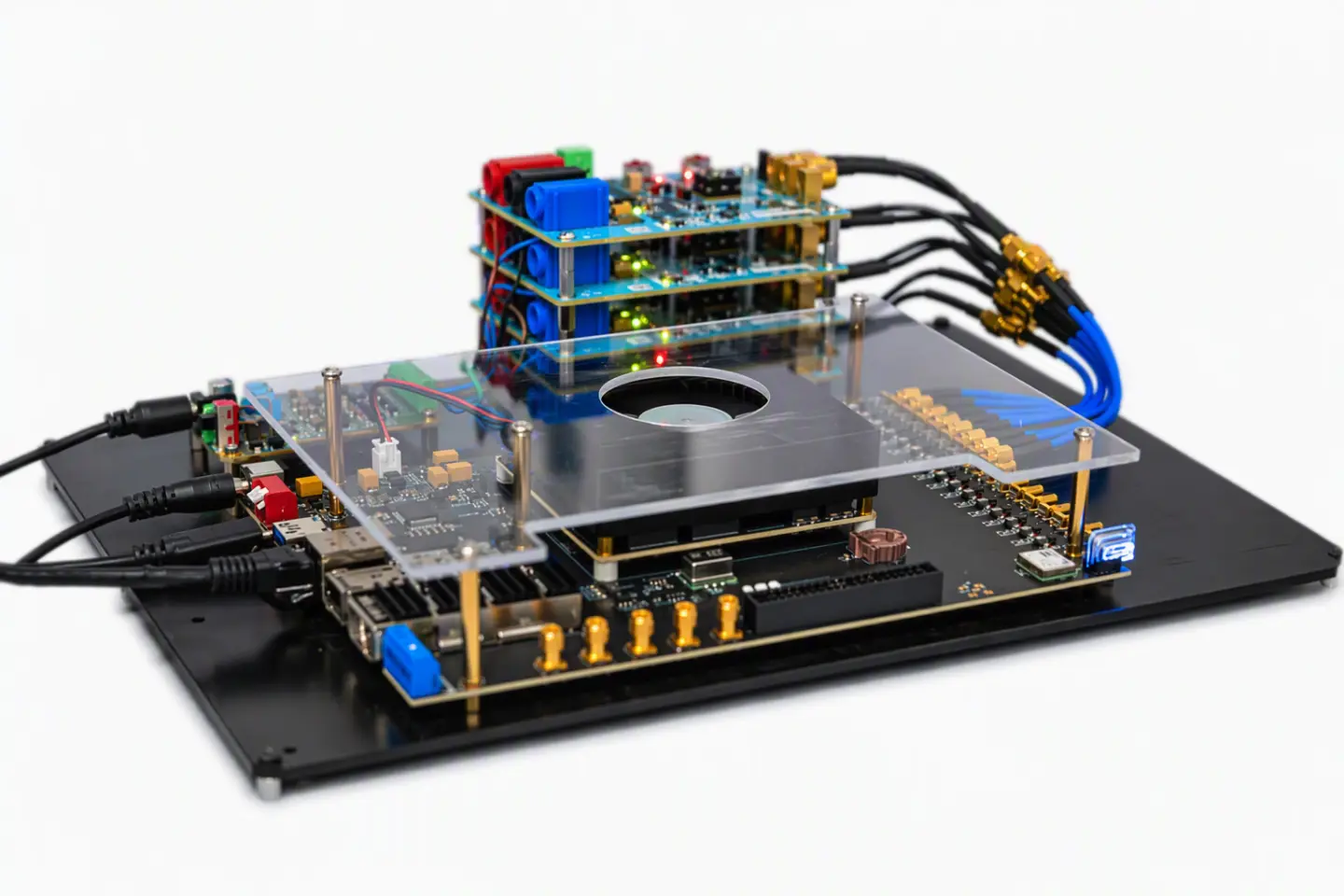
Founded in 2020 by Oxford researchers who won the inaugural Student Entrepreneurs' Programme (StEP) competition, spinning the technology directly out of the University of Oxford's quantum optics research department. QD develops photonics-powered probabilistic computing hardware for NP-hard optimisation problems and next-generation AI beyond the efficient reach of general-purpose compute. AI and optimization workloads are hitting a wall that faster chips alone can't solve: the hardest problems in logistics, finance, defense, and machine learning aren't about raw calculation, but they're about exploring enormous spaces of uncertainty, fast. Classical computers simulate randomness algorithmically, which is slow, energy-hungry, and predictable if the underlying algorithm is ever compromised.
Quantum Dice, an Oxford University spin-out, solves this at the physical layer. The company generates true, physically unpredictable randomness from quantum photonics and continuously self-verifies its integrity in real time — turning randomness from a vulnerability into a trusted computational resource. That capability now powers two product lines: quantum-safe cybersecurity infrastructure (its original, revenue-generating business) and ORBIT™, a new class of Probabilistic Processing Unit (PPU) built to remove the "sampling bottleneck" that limits today's optimization and AI systems.
Key credentials:
Quantum Dice was founded by a team of Oxford physicists and engineers who met through the University's Student Entrepreneurs' Programme, and has since built out a leadership team with deep hardware-commercialization experience.
"Current random number generators are perceived as sufficient, yet proving quantum alternatives' security advantages has been challenging. Our patented technology aims to democratize quantum security."— Dr Ramy Shelbaya, CEO
Dr Ramy Shelbaya, CEO & Co-founder Ph.D. in Atomic and Laser Physics, University of Oxford. Ramy's path to quantum physics started as a teenager in Egypt; he studied physics at École Normale Supérieure PSL in France before his doctorate at Oxford, where he helped lead the team that won the StEP competition and spun Quantum Dice out of the university's quantum optics research. He drives overall strategy, technical partnerships, and international expansion.
Dr Marko von der Leyen, CTO & Co-founder Ph.D. in Atomic and Laser Physics, University of Oxford. Marko brings extensive experience running R&D programs in laser-plasma physics and experimental quantum systems, and leads the technical architecture behind Quantum Dice's hardware and probabilistic computing roadmap.
Wenmiao Yu — Director of Business Development & Co-founder Read Chemistry at the University of Oxford before co-founding Quantum Dice. Wenmiao focuses on converting the company's scientific breakthroughs into market-ready products.
George Dunlop — Director of Partnerships & Co-founder Co-founded Quantum Dice out of a conviction that critical sectors — IoT, defense, financial services, and telecoms — urgently needed more secure, resilient randomness. George leads partnerships across security-sensitive industry and government.
Leadership is further supported by Ambroise Popper (Chief Business Officer, prior CEO/VP roles at Nestwave and Quantenna Communications), James Fok (Chief of Staff, MIT Sloan Fellow and chartered accountant), Dr Annika Möslein (Head of Engineering, Oxford Ph.D.), and Janet Collyer MBE (Chair, 30-year semiconductor industry veteran).
Picks and shovels for the probabilistic computing era. Just as GPUs unlocked deep learning at scale, a new class of hardware is needed to unlock probabilistic computing. Quantum Dice's ORBIT™ PPU is the foundational compute layer purpose-built to remove the sampling bottleneck for optimization and AI, positioning the company as the essential infrastructure for next-generation probabilistic workloads with a TAM spanning both high-assurance cryptography and massive-scale compute.
Solving the industry's hardest problem: trustworthy randomness. Today's approaches are structurally weak — pseudo-random generators are algorithmically predictable, and even hardware-based generators typically can't continuously prove their own integrity. Quantum Dice's patented DISC™ protocol doesn't just generate quantum randomness, it verifies it in real time, moving the industry from "trusted hardware" to "verifiable trust," protected by a growing international patent portfolio.
De-risked by real commercial traction, not just a lab demo. Unlike many hardware-first deep-tech companies, Quantum Dice already has a live, revenue-generating cybersecurity product deployed with telecom and aerospace customers, including public partnerships with BT Group, SpeQtral, and NATS — a real, de-risked channel into its much larger probabilistic-computing opportunity.
Right team, right moment. The founding team combines rare, deep technical credibility — Ph.D.s in Atomic and Laser Physics from Oxford, direct lineage from the university's quantum optics research group — with commercially experienced operators. Probabilistic and energy-efficient computing architectures are moving from academic curiosity to commercial necessity as AI infrastructure costs and energy demands spiral.
How it works, simply: Ordinary computers generate "randomness" using algorithms — which means it's not really random at all, and can potentially be predicted or manipulated. Quantum Dice instead measures the genuinely unpredictable behavior of individual particles of light (photons) using custom-built photonic chips, producing randomness that is physically impossible to predict. The system also continuously checks its own quality and integrity in real time, using a patented technique called DISC™.
The problem it solves: Cybersecurity systems need unpredictable numbers to generate encryption keys and authenticate devices — weak randomness is a well-documented source of real-world security breaches. Separately, probabilistic computing uses controlled randomness to explore huge numbers of possible solutions simultaneously for hard optimization and AI problems. The catch: conventional processors spend the overwhelming majority of their compute simulating that randomness rather than solving the underlying problem — a "sampling bottleneck." Quantum Dice's photonic hardware generates randomness natively and physically, removing that bottleneck.
Key features and benefits: