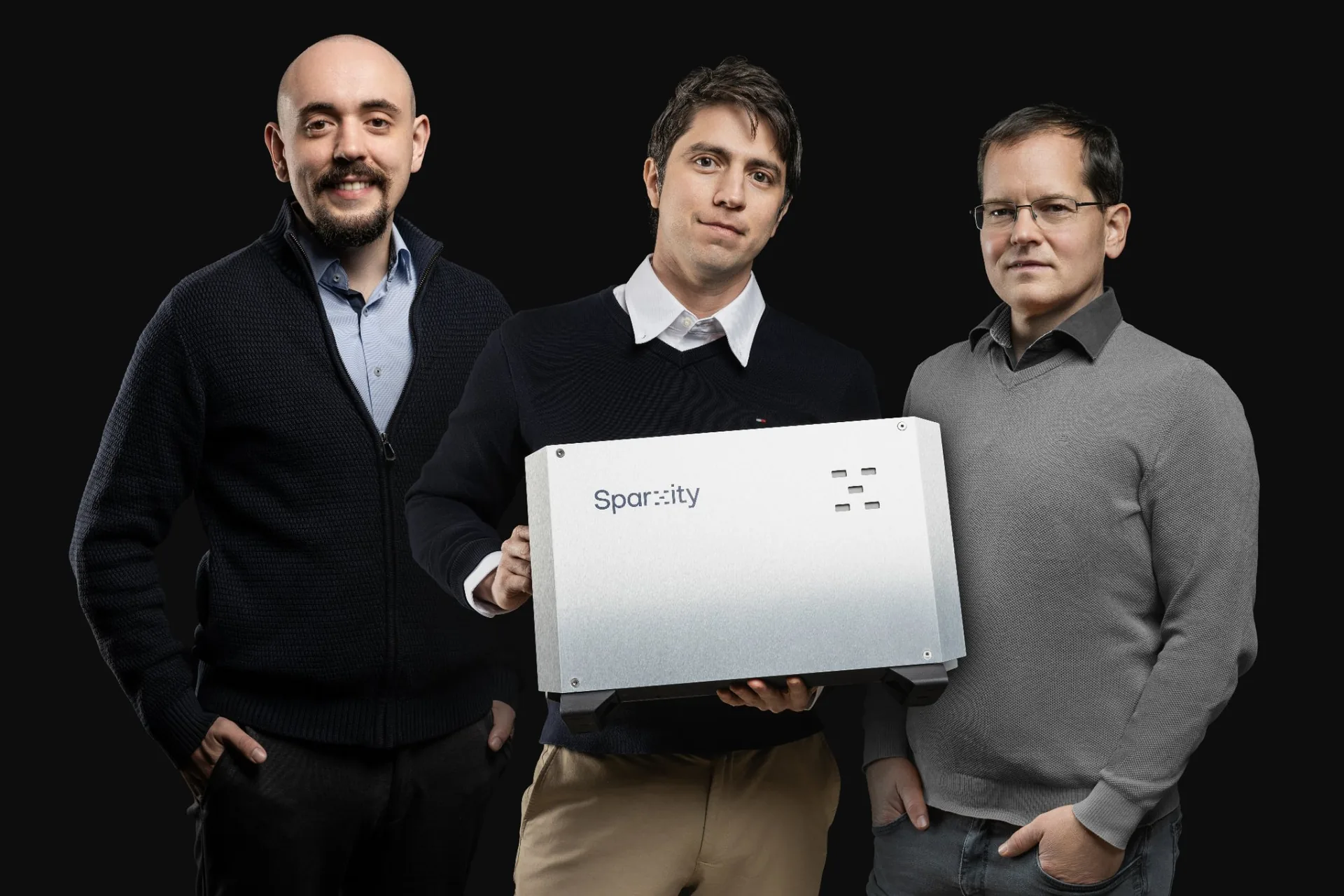
Sparxity, a spin-out of TU Dresden, builds on more than a decade of large-scale computing research carried out with the University of Manchester under the EU's Flagship Human Brain Project. AI infrastructure has hit a bottleneck on memory, energy and most recently in financing. That's why the models themselves are getting sparser through mixture-of-experts (MoE) routing, memory layers and block-sparse attention, so only a small part of a model needs to work at any moment. However, the hardware they run on was built for dense computation. GPUs process everything, every step, and the industry pays for that in power, cooling and cost per token.
Sparxity closes that gap with sparse-native compute. Its systems are event-based: execution units run only when an input changes, so idle parts of a model use no cycles and move no data. The company builds the full stack, from custom chips and boards to racks and software, rather than a chip alone. Its current systems serve both HPC and AI and are deployed at rack and supercomputer scale across Europe and the US. They include a new multi-million-dollar installation at the Jülich Supercomputing Centre, home of JUPITER, Europe's first exascale supercomputer. The next generation is fully dedicated to sparse AI inference, for model builders who want finer, more dynamic sparsity and for data centres and neoclouds that want more tokens per second at lower cost.
In brief:
Sparxity was founded by chip designers and researchers from TU Dresden who have taken custom silicon from academic research to volume production. The team has since grown to more than 70 people across Dresden and the US.
"Scaling fine-granular sparse models has an extremely high potential that is constrained by existing dense hardware. Sparxity exists to unlock them by computing only what matters."— Dr Hector Gonzalez, CEO
Dr Hector Gonzalez, CEO & Co-founder. Ph.D. (summa cum laude) in Electrical Engineering, TU Dresden, where his research focused on AI-enabled chip design for automotive radar, and an M.Sc. in Microsystems from the MIT–Masdar Institute Cooperation Program. He also completed the LBAN Business Scaling program at Stanford Graduate School of Business. Recipient of the 2025 Heinrich Barkhausen Prize for best Doctoral Thesis, he has authored more than 30 archival articles, holds a patent in cognitive radar and is a Fellow of the Konrad Zuse School of Excellence in Embedded Composite AI (SECAI). He leads strategy, commercial expansion and the company's positioning in sparse computing.
Prof. Christian Mayr, Chief Scientist & Co-founder. Christian holds the Chair of Highly-Parallel VLSI Systems and Neuro-Microelectronics at TU Dresden. He earned his Ph.D. summa cum laude and habilitation in engineering from TU Dresden, and a second Ph.D. in Neuroscience from the University of Zurich, where he also conducted research at ETH Zurich. He led the development of the SpiNNaker2 chip architecture through the European Human Brain Project in collaboration with the University of Manchester, laying the technological foundation for Sparxity. Recipient of the Heinrich Barkhausen Prize and Meyer-Struckmann Science Prize, he has authored more than 150 scientific publications and holds five patents. He leads Sparxity's scientific vision and next-generation computing architecture.
Matthias Lohrmann, CTO & Co-founder. Matthias holds a degree in Electrical Engineering from TU Dresden, where his diploma thesis received the Hans-Pundt Prize from VDE Dresden. He gained industrial semiconductor experience at GlobalFoundries and Racyics, specializing in chip design and verification for automotive and ICT applications. He contributed to the development of the SpiNNaker2 architecture through the European Human Brain Project before co-founding Sparxity in 2021. As CTO, he leads the company's hardware and silicon engineering, taking its chips from tape-out through manufacturing and large-scale production.
Picks and shovels for the sparse AI era. Every leading model builder is moving towards sparser architectures because sparsity is the most direct route to scaling capability without scaling cost. Sparxity is building the compute layer designed for that shift. It positions the company as essential infrastructure for model builders, data centres and neoclouds, complementing GPU fleets rather than trying to replace them.
Solving the mismatch at the heart of AI infrastructure. GPUs are superb at dense maths but waste cycles, memory bandwidth and energy on fine-grained sparse workloads, where routing overhead dominates. Sparxity's event-based, sparse-native architecture turns sparsity into speed and efficiency instead of overhead. It is protected by granted patent families in packet routing and chip-to-chip communication.
De-risked by silicon at scale, not just a lab demo. Unlike most AI-chip start-ups at this stage, Sparxity already has production silicon in the field: three tape-outs, more than 70,000 chips produced and systems running at national-lab and supercomputing-centre scale in Europe and the US, most recently the multi-million-dollar JUBIS installation at Jülich.
Right team, right moment. The founders combine world-class research credentials with proven experience of taking custom silicon to volume through an established supply chain. They are building at a moment when AI's energy demand, cost per token and Europe's push for sovereign compute all point the same way. Sparxity is one of very few European companies exporting supercomputer-class systems to the US.
How it works, simply: A conventional AI chip works like a factory where every machine runs at full speed all day, whether or not there is anything to build. Sparxity's systems work the other way round. Each SP2 chip contains 152 small, independent Arm processor cores with memory placed right next to them, and 48 chips sit on each server board. A core only switches on when new information arrives (an "event"). Custom on-chip routing then sends that information only to the cores that need it. Nothing happens and no energy is spent where nothing changes.
The problem it solves: Modern HPC and AI models are increasingly sparse. In a mixture-of-experts model, for example, only a handful of 64–256 "experts" is active for any given word. On a GPU, all that selective routing becomes overhead: the hardware is a big hammer used on fine-grained work. That limits how sparse model builders can afford to make their models, and it drives up energy use and cost per token. Sparxity's hardware is designed so that sparser models run faster and cheaper, not slower.
Key features and benefits: