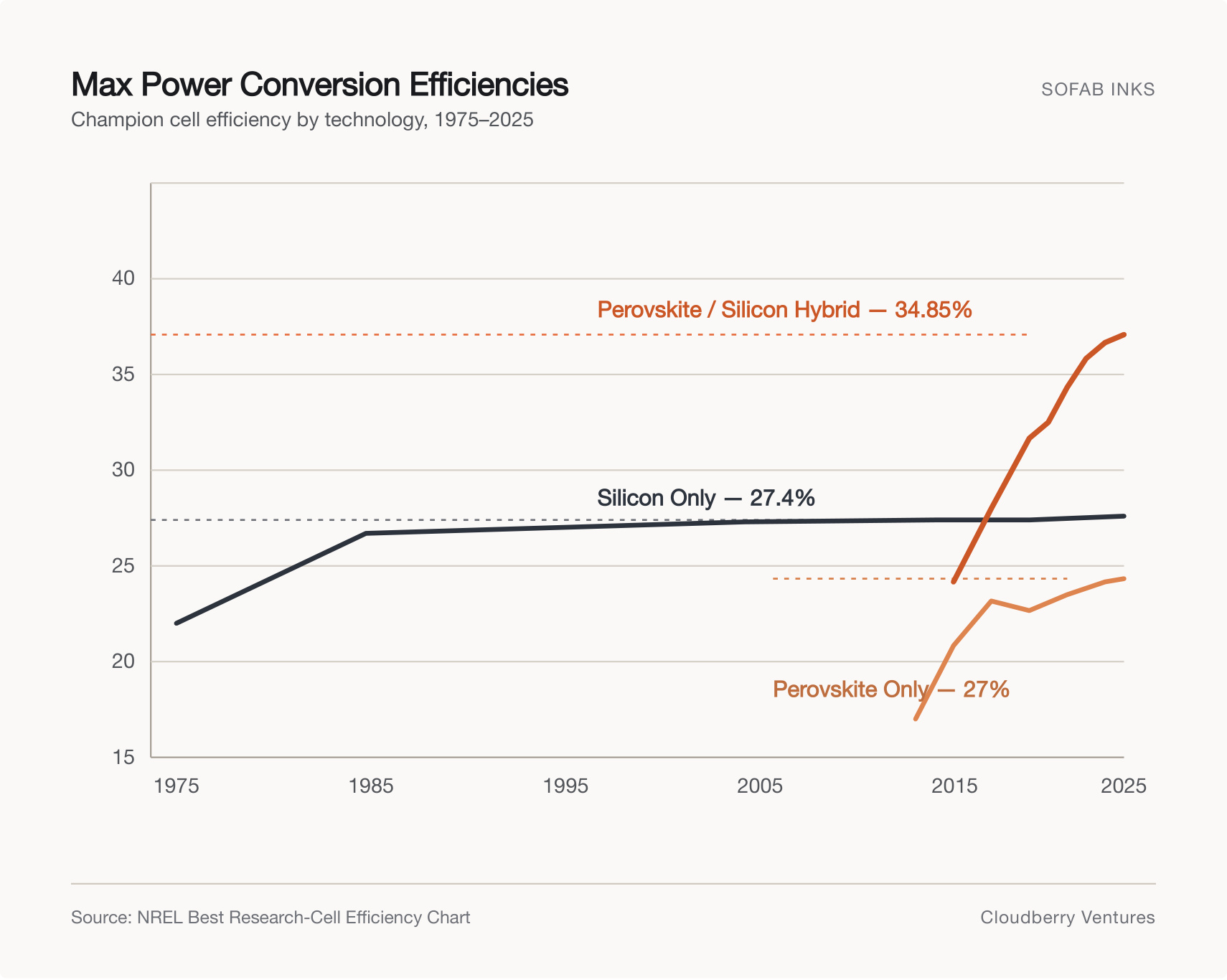
The solar industry is on the brink of a major transition. Perovskite solar cells represent the biggest step up in efficiency and module power in the history of solar technology and have recently reached parity with standard silicon.
But one critical roadblock has stood between the lab and mass commercialization. Perovskite panels are built up in printed layers, and the incumbent material used for the Electron Transport Layer (ETL), a chemical called C60, is fragile, expensive, and limits panel lifespans to just 10 years.
This is the problem SoFab Inks set out to solve, and the moment we saw how, we were sold. Born out of advanced research at the University of Louisville, the founding team recognized that without 25-year stability, perovskite's efficiency gains would never matter commercially. They developed and patented TinFab, a high-performance tin-oxide (SnO₂) nanoparticle ink that replaces C60 outright. Today, SoFab holds a four-year first-mover advantage, has scaled from lab samples to industrial volumes, and is actively field-testing its materials on the multi-gigawatt production lines of the world's largest solar manufacturers.
The first time we met Blake and the team, we were deeply impressed by their domain expertise, their vision for the solar industry, and their boldness in tackling an issue that has been the key bottleneck for the perovskite revolution, paired with the execution to put that vision into practice.
"A perovskite cell is only as good as its weakest layer, and the industry has been stuck with a fragile, underperforming material at its core. That's the layer we replace," Blake Martin
Blake Martin, Ph.D., Co-Founder and CEO. A chemical engineer with extensive experience in scalable nanoparticle manufacturing, Blake leads SoFab's strategic vision and has grown the company's client base to 50+ global manufacturing partners. With fresh seed funding in hand, he's now tripling the engineering team to take SoFab's technology from lab-scale into high-velocity, commercial-format production.
Peter Armstrong, Ph.D., CTO & Co-Founder A chemist who scaled SoFab's chemical processes from lab-scale to 100L+ reactions. He manages international logistics and compliance, and built the company's perovskite R&D lab from the ground up.
Sashil Chapagain, Ph.D., CSO & Co-Founder Chief architect of SoFab's core material formulations. He leads product development, including non-aqueous SnO₂ and SnO₂/polymer composites, and oversees the quality control and performance analysis that keeps TinFab meeting rigorous commercial stability standards.
Jack Manzella, MBA, COO & Co-Founder An operations and commercialization expert. Before SoFab, he graduated from GE's Leadership Development Program and directed commercialization strategy at GE's FirstBuild. He also serves as an Entrepreneur in Residence at the University of Louisville.
We see SoFab Inks as a "picks and shovels" opportunity in one of the most important shifts in energy: the move to perovskite solar. As electrification accelerates across transport, industry, and the data centers powering AI, solar remains the cheapest source of new power available and perovskite is what unlocks its next leap in performance, along with entirely new form factors that silicon can't serve.
Solving the industry's hardest problem. Perovskite's promise has always been capped by a single weak point: the electron transport layer, where the incumbent material has been the primary source of voltage loss and the first point of failure in the field. SoFab's materials are built specifically to remove that constraint, giving perovskite a credible path to the durability that mass deployment requires.
Deep, broad-based industry validation. Rather than a single flagship partnership, SoFab has built engagement across a large share of the perovskite manufacturing ecosystem, spanning equipment makers, research labs, and module manufacturers who are independently validating the material's performance and stability in their own processes. That breadth of validation, rather than reliance on any one partner, is a large part of what gives us confidence in the company's trajectory.
Right team, right moment. SoFab's founding team combines the deep materials science needed to solve this problem with the commercial execution needed to scale it. Combined with rapidly accelerating demand for high-performance, low-cost solar, we believe SoFab is well positioned to become a foundation
A perovskite solar panel works by stacking discrete material layers that absorb light and transport electrons.
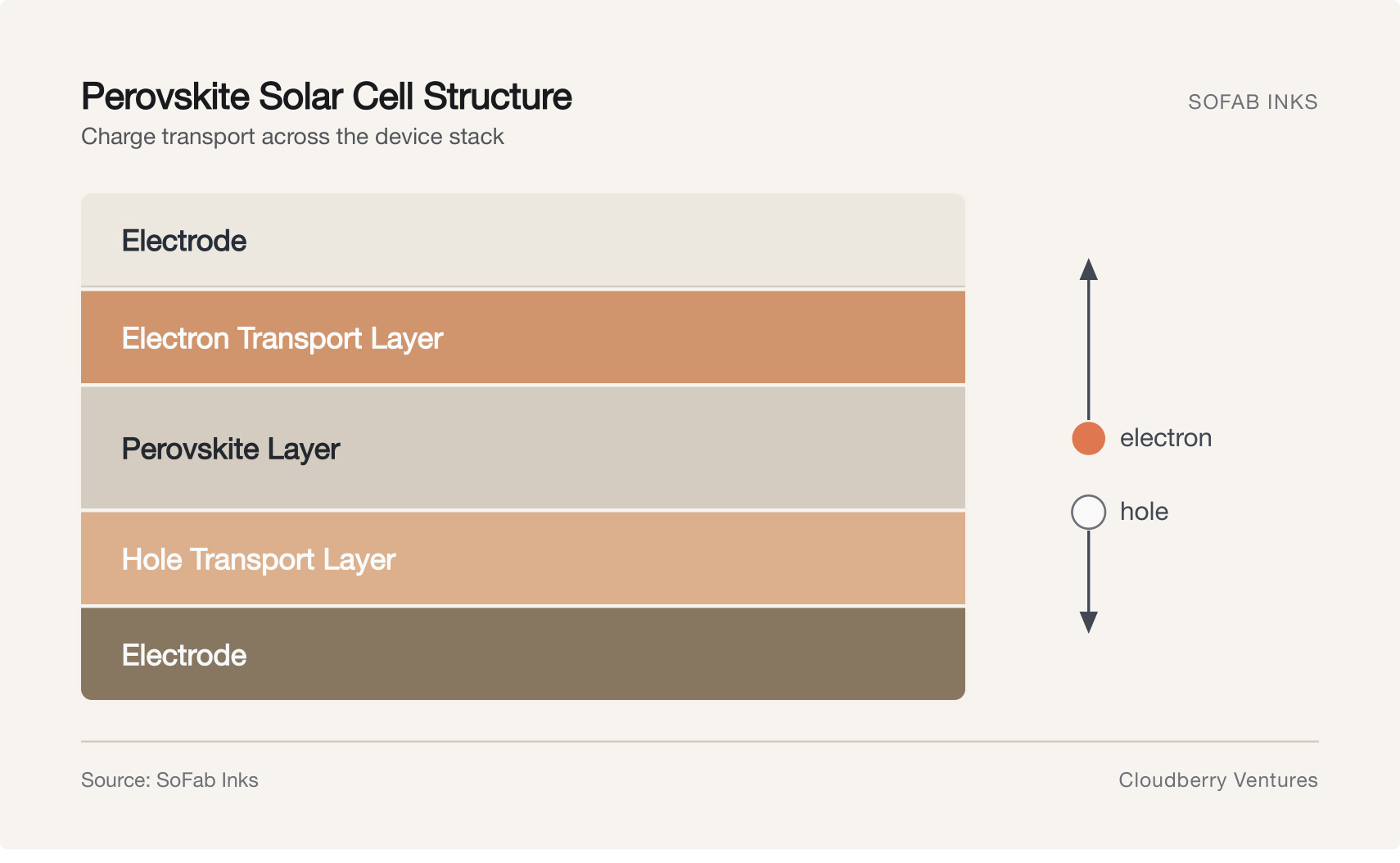
The industry's major bottleneck has been the Electron Transport Layer. Manufacturers have relied on an organic material called C60, which requires a slow, 10+ step vapor deposition process and acts as a mechanical weak point which is causing panels to delaminate (peel apart) under heat and moisture.
SoFab's TinFab replaces C60 with a fully inorganic, proprietary tin-oxide (SnO₂) nanoparticle ink:
%20(1).jpg)